
Social Security’s main retirement trust fund is on track to shrink by over $200 billion this year — which would be a record — as Americans grow increasingly concerned about its ability to pay full benefits into the future.
The latest projections indicate that the Old-Age and Survivors Insurance, or OASI, trust fund will become insolvent in 2032 if Congress doesn’t act. That’s why you’ve probably heard some version of the statement that Social Security is “running out of money.”
Must Read
- You're probably eligible to save money on car insurance. Compare rates for your ZIP code with this free -- and fast -- tool from Money.
- These 6 hacks can help seniors save money on things they're already buying.
- Meet your financial goals faster: Take this free, no-obligation quiz to get matched with an advisor today.
Social Security benefits are primarily funded by payroll taxes, paid in equal parts by employees and employers, and the trust fund. The fund’s financial status has been a source of concern for decades: Anticipating the eventual retirements of tens of millions of baby boomers, lawmakers elected to build it up using tax dollars beginning in the 1980s. In a historic set of amendments, Congress shored up the program by shifting the retirement age to 67 and introducing a tax on the benefits of high earners, among other changes.
Now, the baby boomer generation is retiring, but the math isn’t exactly mathing.
The program has been drawing down the OASI trust fund for the past five years, as Social Security’s current income is not enough to pay out benefits from payroll taxes alone. If the Social Security trust fund is ultimately depleted, beneficiaries will see an estimated 22% reduction in benefits.
The crucial question here isn’t why the trust fund is shrinking, says Stephen Goss, former chief actuary of the Social Security Administration. It’s why this is happening three decades sooner than actuaries expected in 1983, when the trust funds were projected to last until about 2060.
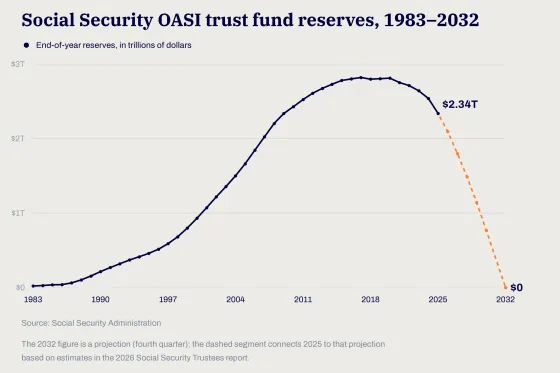
At its peak in 2017, the trust fund held $2.82 trillion.
Last year, the trust fund shrank by $200 billion, dwindling from $2.538 trillion at the end of 2024 to $2.338 trillion at the end of 2025. It was the largest drop on record.
The 2026 Social Security Trustees report, released in June, projects the trust fund reserves will reach $2.095 trillion at the end of this year. That would be a drop of $243.3 billion and would mark the fourth-straight year of accelerating declines.
Here’s why Social Security’s retirement trust fund is running out of money so quickly:
Earnings over the payroll tax limit
The growth in income among top earners in America has far exceeded projections, says Goss, who retired in 2025 after more than 50 years at the Social Security Administration.
Social Security is funded by payroll taxes that total 12.4%. Employees owe 6.2% of their covered wages toward Social Security, and their employers pay the same share. But the taxes workers and employers pay on Social Security stop at an income threshold ($184,500 in 2026).
When income gains are concentrated at the top, the share of overall income that’s taxed for Social Security slips. That’s exactly what happened from 1983 to 2000, Goss says.
Over that 17-year span, average earnings of the top 6% (approximately the share of workers with earnings over the taxable maximum) grew 42% after adjusting for inflation. Earnings of the bottom grew just 17%, he says.
The share of earnings subject to Social Security taxes fell from about 90% in 1983 to around 82% since 2000, according to Goss.
“That was a big loss in income,” he says.
Democrats often favor Social Security funding solutions that involve increasing taxes on high earners. Bills like the Protecting and Preserving Social Security Act from Sen. Mazie Hirono, D-Hawaii, would eliminate the payroll tax cap altogether. Republican lawmakers generally oppose the idea, viewing it as a harmful tax increase, though there is some bipartisan support.
The depth of the Great Recession
The Great Recession — which ran from 2007 to 2009 — was the other major accelerant of the trust fund’s depletion, Goss says, with unemployment and declining wage growth affecting the program’s income.
In 2007, the Social Security Trustees report projected that the trust fund would be exhausted in 2042; two years later, the projected insolvency year had moved up to 2039, in part due to the hit to payroll tax collection stemming from widespread job loss.
Birth rates were also heavily impacted as families reconsidered their financial ability to raise children. This is having consequences for Social Security nearly two decades later as those babies reach working age.
The birth rate is critical for Social Security because current retirees’ benefits are paid with income taxes largely from working-age Americans. Fewer births means fewer workers per beneficiary.
Some quick history: Up until 1965, the fertility rate, defined as the number of children per woman, was around 3 or higher. By 1976, for a myriad of reasons (some economic), it had fallen to just 1.74.
“Here’s the good part,” Goss says. “By 1990, it was back up to a birth rate of 2.0, and it stayed at that level through 2007” before a freefall when the recession hit. He adds: “And here’s the really sad part … the birth rate hasn’t really recovered from that drop off.”
Combined with the higher-than-expected share of income going to the top, the recession kept the trust fund from reaching the peaks actuaries were banking on, Goss says.
The recession also led some Americans to retire and claim Social Security earlier than they otherwise would have, according to the Urban Institute. But the tradeoff for claiming Social Security at a younger age is lower monthly payments, meaning the financial health of the program is largely independent of when people claim.
Inside lawmakers’ Social Security blame game
The question of why Social Security’s trust fund is headed toward insolvency so soon overlaps with some contentious partisan debates.
Republicans sometimes point to waste and fraud. The Social Security Administration under Frank Bisignano, IRS CEO and Social Security commissioner, recently announced progress toward correcting tens of millions of records, adding death dates and fixing citizenship statuses.
“The president has been very, very clear. Protect and preserve. The first steps of protecting was to get the operations to work right. Any good business fixes its technology, fixes its operations, fixes its books and records, and that’s what’s been going on,” Bisignano told Fox Business.
The agency did not respond to Money’s request for comment about whether these efforts have stopped any improper Social Security payments or helped the program’s finances.
Bisignano’s comments come after the Department of Justice said in September that it had ramped up “enforcement actions targeting fraud” in Social Security. The DOJ announcement highlighted charges against 17 people, including a woman accused of hiding her deceased mother in a garage freezer for two years to continue collecting her Social Security benefits.
In total, the DOJ reported $1.34 million in alleged intended losses — pennies compared to the $1.6 trillion Social Security paid out last year as the biggest line item in the U.S. government’s budget. Goss says he’s seen no evidence that fraud is behind the depletion of the trust fund in a significant way.
Democrats, for their part, are blaming Social Security issues on Trump’s border and immigration policies and the One Big Beautiful Bill Act.
The July 2025 law extended income tax cuts and added a new, temporary “senior bonus” deduction. “As a result, less income tax will be paid on Social Security benefits, and the OASI and DI Trust Funds will receive lower levels of revenue in the future from income taxation of Social Security benefits,” according to the 2026 Trustees report.
The enactment of the law moved up the projected depletion date from early 2033 to the fourth quarter of 2032, Social Security’s chief actuary, Karen Glenn, wrote in an August 2025 letter.
It’s harder to calculate the effects of immigration policies on the program’s finances. Some workers without legal status pay Social Security taxes despite being ineligible for benefits, so deportations and tighter border control can have an impact.
Likewise, legal immigration, which is down under Trump, can boost Social Security’s finances. Immigrants typically work and owe payroll taxes. Whether they later qualify for benefits depends on satisfying the program’s requirements, including earning at least 40 work credits, equivalent to about 10 years of work.
Less immigration also means a lower birth rate, Goss says.
These are just a few of the many factors affecting how quickly Social Security’s trust fund is running out of money. We’ve also covered the back-and-forth over the Trump administration’s clawbacks of overpayments, the Social Security Fairness Act of 2025 (which increased benefits for millions of public-sector workers) and the effects of recent inflation on COLAs.
All of these things affect insolvency date projections at the margins, but the broader takeaway is that Congress is on the clock. Lawmakers have only a handful of years left to choose from an array of Social Security fixes, all of which would be painful in one way or another for retirees or taxpayers, to stave off a major benefit cut.
Never miss a Money story.
- Join 700,000+ readers who get the latest financial news and advice delivered daily for free. Subscribe to our newsletters.