
If you get a text message claiming to be from the IRS this week, your first instinct is probably to delete it and block the number.
And that's usually smart. After all, the IRS famously warns that it "will not contact [you] by text message or social media."
But dropping the hammer too quickly might cause you to miss a legitimate government notification — or, worse, an alert that a scammer is trying to compromise your tax data. (According to the U.S. Congress Joint Economic Committee, almost 25% of Americans have reported being victimized by tax scams, including spoofed text messages and QR codes.)
Adding to the confusion is the fact that the IRS can now text you. In recent years, the federal tax agency has introduced three very specific reasons it will text your mobile phone, and one glaringly obvious reason it still won’t.
Here's how to know who's on the other side of that "message received" prompt.
The IRS rolls out text messaging

The IRS only began rolling out SMS text messaging in the last eight years or so. Things like opt-in account updates, initiated system reminders, and requested callback confirmations that may have required paper letters or wait times in the past may now land in your digital inbox.
However, there are two important caveats to receiving an IRS text message.
First, the IRS will only text you if you opt in. Second, the federal tax agency uses strict, dedicated short codes to send texts to your phone.
So if you receive a text claiming to be from the IRS via a standard 10-digit phone number, it's likely a fake. Legitimate short codes are below:
- Short code 91040: Used for official IRS news bulletins (like changes in the tax code), appointment reminders, account notifications, and one-time security codes.
- Short code 34381: Reserved for IRS customer service callback reminders.
(Note: While these are the primary codes deployed by the agency, the list may expand as digital services evolve.)
But a word of caution: The IRS will never text you for personal or financial account information, payments, or passwords. So even if a message appears to come from a verified short code, be wary: sophisticated scammers can make them look legit.
Furthermore, receiving an unexpected short-code text — like a sudden two-factor authentication code you never requested — doesn't necessarily mean the message itself is inherently fake. Instead, it might be a sign that a hacker is attempting to breach your online IRS portal account.
Never give that security code to any individual, even if they claim to be an IRS agent. If you suspect fraudulent activity, log directly into your IRS portal to check your account status.
To help keep your identity and wallet safe, here are three key reasons you might receive a text claiming to be from the IRS, and one reason you won't.
1. You subscribed to IRS news bulletins
Not many people realize you can subscribe to direct IRS communications and receive a text message.
Everything from new tax law regulations (like those governing the recently launched Trump Accounts) to IRS criminal investigation tax case highlights can be delivered right to your inbox.
Taxpayers initially subscribe to these notifications via email (usually coming from irs@service.govdelivery.com). However, the IRS system allows you to opt in to text alerts as well, as demonstrated by this snapshot of a Tax Stats Dispatch Mailing List email sent from the IRS:
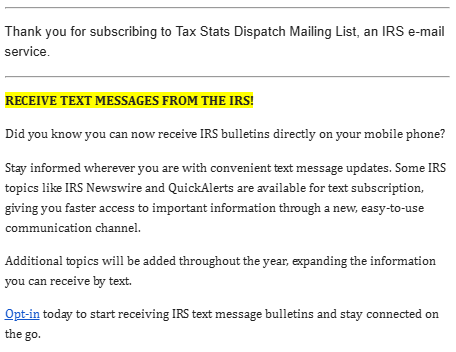
If you decide to receive IRS bulletins via text, the updates will always originate from the secure short code 91040. A different number delivering the tax law updates is likely a phishing attempt designed to steal your credentials.
2. You have an upcoming IRS appointment
When you schedule an in-person meeting at an IRS Taxpayer Assistance Center (TAC), you can opt in to receive text confirmations and scheduling updates about that appointment.
The IRS will also text you a notification once you're checked in at the building or when it is your turn to be seen (a screenshot of what an appointment reminder may look like can be found on Reddit).
Just like news bulletins, these automated operational texts will come from short code 91040.
However, scammers can use fake IRS appointment reminders to trick you into "confirming your appointment" by clicking a link or handing over personal or financial information.
To play it safe, never click a text link. Instead, log directly into your secure IRS online account to verify your appointment status. If you're still unsure, call the IRS customer service line directly at 1-800-829-1040 to double-check your appointment time.
Stop Overpaying Your Taxes. Subscribe to Tax Tips, our weekly no-cost newsletter, for timely tax-cutting strategies and guidance to help you keep more of your hard-earned money.
3. You requested an IRS callback
Holding on the line for an IRS agent can feel grueling. According to the Taxpayer Advocate Service, taxpayers this past filing season had more difficulty reaching the federal tax agency than last year, with an average reported wait time of 14 minutes (up from 8 minutes). Only about 21% of calls were answered by an agent.
To alleviate the gridlock, the IRS offers a digital callback service for select high-volume phone topics, like refund inquiries and how to pay the IRS if you owe taxes. So instead of waiting on hold, you can opt in to receive a text when an agent is ready to call you back.
These text alerts generally only come from short code 34381.
But as you might've guessed, scammers can take advantage of this method as well.
Potential fraudsters can impersonate the IRS callback service to gain your trust before trying to extort personal information or demand immediate payment.
You can typically verify the text by its timing: the message should arrive within a predictable window after you personally initiated a call to the IRS. If you get a random "callback" text out of the blue, it's probably a red flag.
The one thing the IRS will never text you
Although the IRS will text you for administrative and scheduling updates you opt into, the federal tax agency will never initiate a text message demanding payment.
The hallmark of a text tax scam is typically a claim that you owe back taxes, have an "unclaimed refund" waiting to be deposited, or must urgently click a link to "fix" a suspended account, per the IRS' latest Dirty Dozen report (an annual list of the current tax scams).
But remember: legitimate IRS texts will never feature hostile, high-pressure language like "pay now or face arrest," nor will they send unexpected links or attachments. Legitimate federal tax agency communications almost always arrive first through physical mail via the U.S. Postal Service (unless you opt in for digital).
And if an unsolicited message lands on your phone offering "free tax advice," demanding your Social Security number, or asking you to scan a QR code, do not engage. Instead, take a screenshot (or copy the text) and forward it to phishing@irs.gov with the following information.
- Subject line: "Text."
- Sender's phone number and your phone number
- Date, time, and time zone received.
Then forward the text to 7726 (SPAM) to alert your mobile carrier and delete the message.
Stay alert.
Read More
- What Are Your Chances of an IRS Audit? 15 Audit Red Flags
- Gifting Cash for a Wedding or Graduation? Here's a Quiz on IRS Gift Tax Rules
- How Benjamin Franklin's Simple Money Rules Could Help Lower Your 2026 Taxes